Qigong, Tai Chi, and Standing Pillars
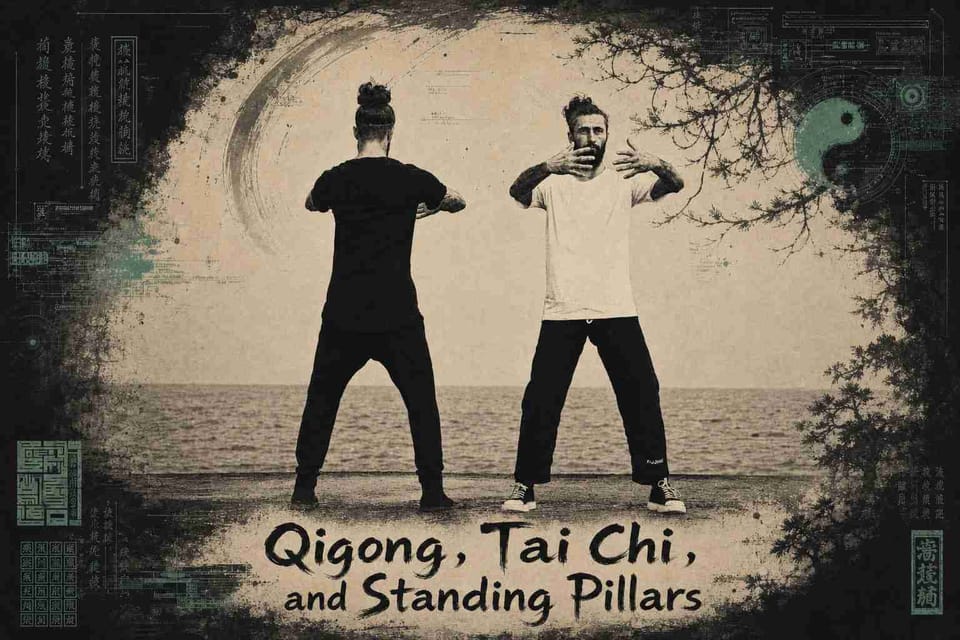
Although Qigong, Tai Chi, and Standing Pillars are closely related, they serve different purposes.
Qigong is the foundation. It develops body structure, breathing, coordination, and the smooth circulation of Qi through a combination of movement, breathing techniques, and focused attention. Some Qigong methods are dynamic, while others are performed in stillness.
Tai Chi Chuan (Taijiquan) is an internal Chinese martial art. It applies the principles developed in Qigong to movement, martial technique, partner training, and combat. The slow movements are not the goal themselves—they are a method for improving structure, balance, coordination, and internal power.
Standing Pillars (Zhan Zhuang) are a specific training method used in many internal martial arts. Instead of moving, the practitioner holds a series of standing postures for a period of time. This develops body structure, rooting, balance, endurance, and the ability to maintain relaxation while supporting the body with correct alignment.
Although these disciplines can be practised independently, they naturally complement one another. Qigong teaches the body to move correctly. Standing Pillars teach the body to maintain correct structure without movement. Tai Chi combines both qualities and applies them in continuous motion.
For this reason, our course begins with Qigong, continues with Standing Pillars, and later progresses to Wooden Pillar Work, partner training, and traditional Chinese martial arts. Each stage builds upon the previous one, creating a complete and systematic training method.
 Medelian Twins


Member discussion